
Download Now


Share with your community!
Pet Community
History remembers Abraham Lincoln as the president who led the United States through the Civil War and abolished slavery.
But away from the speeches, political battles, and endless responsibilities, there was another side to Lincoln that many people never see.
He loved cats.
Not casually.
Not occasionally.
He adored them.
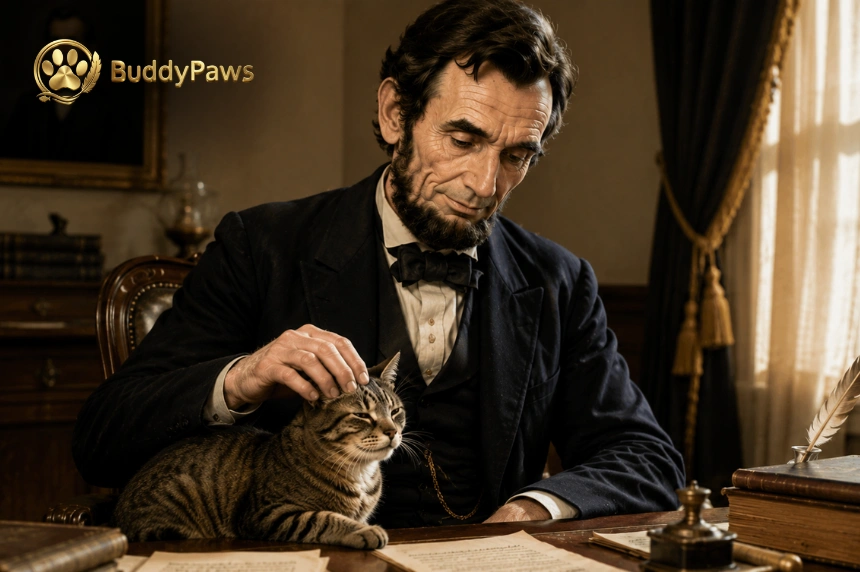
During some of the darkest years in American history, Lincoln found comfort in the quiet company of his feline companions. They became his source of peace in a world filled with conflict, loss, and impossible decisions.
When Abraham Lincoln became president in 1861, he and his family moved into the White House with their sons, Robert and Tad.
One member of the family, however, had to stay behind.
Their beloved dog, Fido, remained in Springfield, Illinois, because the Lincolns believed the journey and the busy atmosphere of Washington would be too stressful for him.
It did not take long before new companions entered the White House.
Later that year, Secretary of State William Seward gave Lincoln two kittens as a gift.
Lincoln named them Tabby and Dixie.
Those two kittens quickly became some of the president's favorite companions.
Tabby and Dixie were never treated like ordinary pets.
Lincoln spent hours holding them, talking to them, and letting them follow him around the White House.
His wife, Mary Todd Lincoln, once remarked that her husband's only real hobby was cats.
While other presidents enjoyed hunting, horseback riding, or collecting books, Lincoln found happiness in sitting quietly with his cats.
For a man carrying the burden of an entire nation, those simple moments meant everything.
One of the most memorable stories about Lincoln's love for cats happened during a formal White House dinner.
As guests enjoyed an elegant meal, Lincoln noticed Tabby nearby.
Without hesitation, he picked up a gold fork and began feeding the cat directly from the dining table.
Mary Todd Lincoln was horrified.
She believed it was completely inappropriate during such an important event.
Lincoln simply smiled and replied,
"If the gold fork was good enough for former President James Buchanan, I think it is good enough for Tabby."
It was a humorous response, but it also showed something deeper.
Lincoln cared far more about kindness than appearances.
Lincoln often joked about politics.
Sometimes, those jokes involved his cats.
On one occasion, after another difficult day dealing with political disagreements, he looked at Dixie and reportedly said,
"Dixie is smarter than my whole cabinet. I'd rather talk to her than any of them. She doesn't talk back."
Whether he intended it as humor or frustration, the remark revealed how much comfort he found in the quiet presence of his pets.
Cats asked for nothing.
They offered no political opinions.
They simply stayed close.
Lincoln's love for animals extended far beyond Tabby and Dixie.
In 1865, while visiting General Ulysses S. Grant's headquarters during the Civil War, Lincoln heard faint cries nearby.
Following the sound, he discovered three orphaned kittens.
He gently picked them up and held them in his hands.
Looking at the tiny animals, he quietly said,
"Kitties, thank God you are cats, and can't understand this terrible strife that is going on."
Before leaving, Lincoln made sure someone would care for them.
He instructed the soldiers to feed the kittens milk and treat them kindly.
Even during one of the bloodiest conflicts in American history, he took time to protect three helpless animals.
The presidency during the Civil War was filled with enormous pressure.
Every day brought difficult decisions, heartbreaking news, and unimaginable responsibility.
Lincoln carried that weight for years.
Many historians believe his cats offered something rare.
Silence.
Comfort.
Unconditional companionship.
Unlike politicians or military leaders, cats demanded nothing except kindness.
For a few quiet moments each day, Lincoln could simply be himself.
Abraham Lincoln is remembered for changing history.
But stories about Tabby, Dixie, and the orphaned kittens remind us of another important part of his character.
He believed kindness mattered.
Not only toward people.
But toward animals as well.
His love for cats showed that even the most powerful person in the country could find comfort in the gentle purr of a kitten.
Sometimes, the smallest companions make the biggest difference.
Behind every great leader is a human being.
For Abraham Lincoln, that humanity could often be seen in the way he cared for animals.
His cats were more than pets.
They were trusted companions during the hardest years of his life.
In a White House filled with political conflict and wartime decisions, Tabby and Dixie offered something priceless.
Peace.
Perhaps that is why, more than 150 years later, stories of Lincoln and his beloved cats continue to warm the hearts of animal lovers around the world.
Loading blogs...