
Download Now


Share with your community!
Pet Community
Imagine walking into a crowded room, hearing your name, and instantly turning around to answer.
Now imagine doing that underwater.
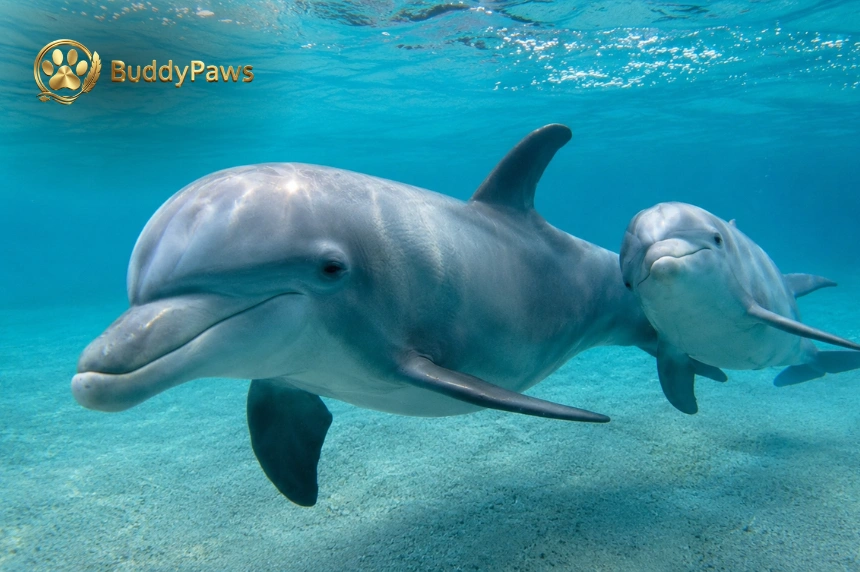
That is exactly what bottlenose dolphins appear to do.
Scientists have discovered that these remarkable marine mammals create individual “signature whistles” that function much like personal names. And the most fascinating part? Other dolphins learn those whistles and use them to call specific individuals.
Research has shown that during the first year of life, a young bottlenose dolphin develops a unique whistle pattern.
This whistle is not random noise.
It contains a distinctive combination of frequencies, timing, and melody that identifies that dolphin alone.
Once established, the signature whistle usually remains stable for life, becoming a permanent acoustic identity.
In human terms, it is the closest thing in the animal kingdom to having a personal name.
The real breakthrough came when scientists discovered that dolphins do more than simply broadcast their own identity.
They also imitate the signature whistles of other dolphins.
When one dolphin wants the attention of a specific companion, it may reproduce that individual’s whistle pattern.
That means a dolphin is not merely saying “Here I am.”
It may be saying “Hey, Sarah, come here.”
This is extraordinarily rare in the animal world because it involves learning and using another individual’s unique vocal label.
Researchers conducted playback experiments in which dolphins were played recordings of signature whistles.
When a dolphin heard its own signature whistle, it typically responded immediately by producing the same whistle.
The behavior strongly resembled a human answering when someone calls their name.
Importantly, dolphins did not show the same response to unfamiliar whistles, suggesting they recognized their own acoustic identity.
This provided some of the strongest evidence that dolphins possess a sophisticated system of individual recognition.
Bottlenose dolphins are highly social animals that form complex friendships, family bonds, and long term alliances.
Male dolphins, in particular, often cooperate in stable groups for many years.
Scientists have found that these allied males sometimes gradually modify their whistles to share certain sound elements.
Think of it as a vocal badge of group membership.
While each dolphin retains its individual identity, the shared whistle features may signal:
It is somewhat similar to humans sharing a surname, accent, or group chant.
Many animals recognize one another.
Birds know their mates.
Elephants recognize family members.
Dogs recognize familiar voices.
But dolphins appear to go a step further.
They use learned, individually specific vocal labels that can be copied and directed toward particular individuals.
This level of vocal flexibility and social intelligence is one reason dolphins are considered among the most cognitively advanced animals on Earth.
When we watch dolphins leap through waves, we often focus on their athleticism.
What we cannot see is the invisible conversation happening underwater.
A pod of dolphins may be exchanging information about identity, location, relationships, and group coordination through a rich network of whistles.
Each whistle carries social meaning.
Each response reinforces connection.
The ocean, in a sense, is filled with names being called back and forth.
Dolphin signature whistles challenge the old assumption that complex symbolic communication belongs only to humans.
They suggest that another species has evolved a system for:
While dolphin communication is not the same as human language, it reveals a level of social sophistication that continues to surprise scientists.
The next time you see a bottlenose dolphin, remember that you may be looking at an animal that has:
Beneath the waves, dolphins are not simply making sounds.
They are calling one another by name, maintaining friendships, alliances, and family bonds in a hidden world of whistles that we are only beginning to understand.
Loading blogs...