
Download Now


Share with your community!
Pet Community
Long before cities, farms, written language, or modern homes, humans already had dogs beside them.
A major 2026 study published in Nature revealed the oldest genetic evidence of domestic dogs yet discovered. Researchers identified a dog from Pınarbaşı in central Türkiye that lived around 15,800 years ago, pushing confirmed genetic evidence of dogs thousands of years deeper into human history.
What makes the discovery so powerful is not just the age of the bones.
It is what they tell us about the relationship between humans and dogs.
Thousands of years before agriculture began, hunter gatherers were already sharing food, space, and daily life with dogs.
The bond we celebrate today may be one of the oldest relationships humans have ever formed with another species.
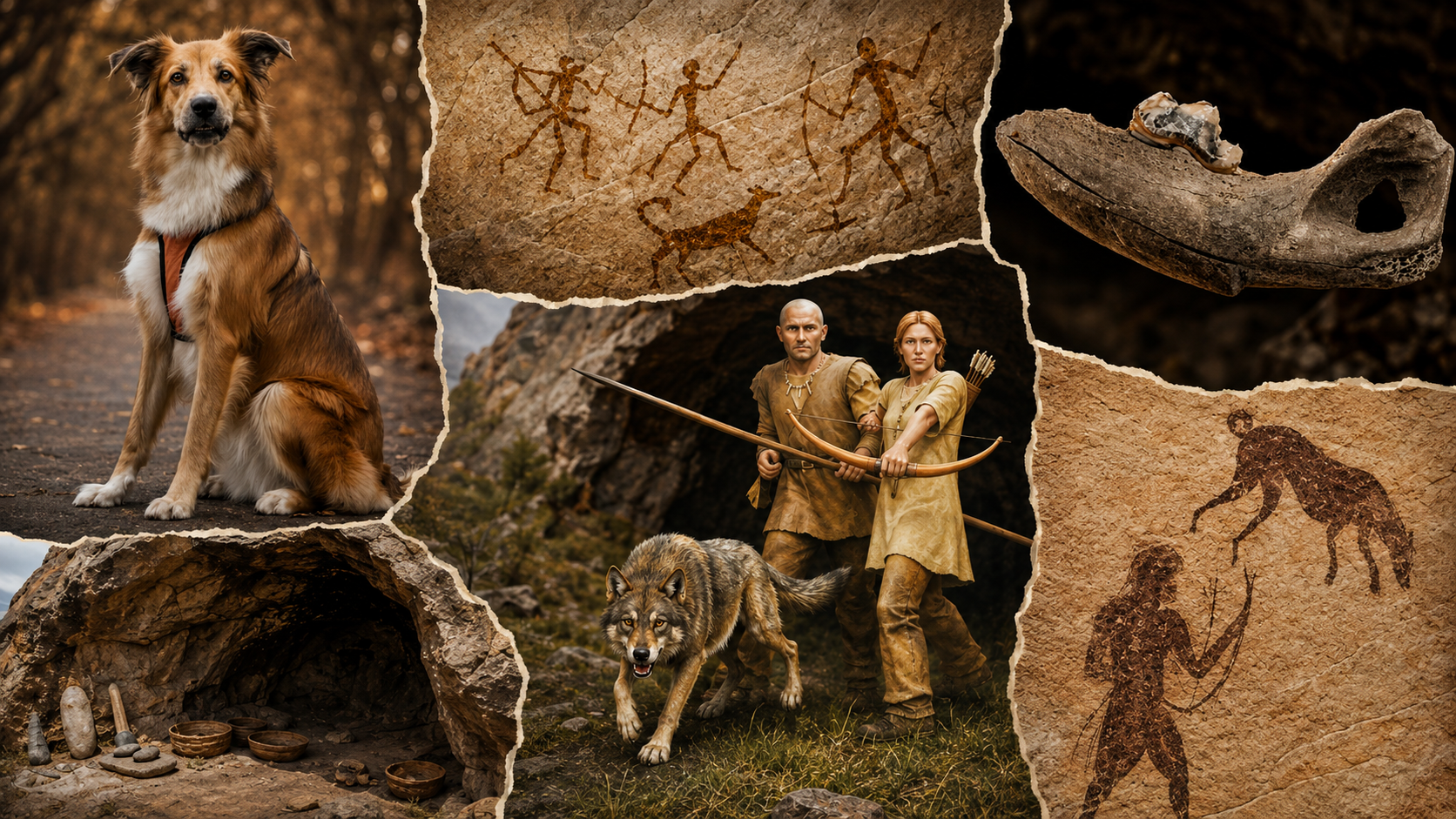
The remains were discovered at Pınarbaşı, an archaeological site on the Central Anatolian Plateau in Türkiye.
Using ancient DNA, researchers confirmed that a canine living there roughly 15,800 years ago was genetically closer to domestic dogs than wolves.
Before this discovery, the earliest unequivocal genetic evidence for dogs dated to around 10,900 years ago.
That means the new finding pushed the confirmed genetic record back by nearly 5,000 years.
Even more remarkable, this dog lived among hunter gatherers.
There were no farms.
No cities.
No supermarkets.
No modern concept of pet ownership.
Yet dogs were already part of human communities.
The researchers did not stop at DNA.
They also examined chemical signatures preserved in the animals' bones.
Isotope analysis suggested that people at Pınarbaşı were likely feeding dogs fish that humans themselves were eating.
That detail changes the way we imagine these ancient animals.
This was not necessarily a wolf lingering at the edge of camp waiting for discarded scraps.
The evidence suggests a much closer relationship.
Humans appear to have actively shared resources with dogs.
Food was precious during the Ice Age.
Giving part of that food to another animal meant something.
Perhaps dogs helped with hunting.
Perhaps they provided protection.
Perhaps they offered companionship.
Most likely, their role changed depending on the community and individual dog.
Whatever the reason, humans were making room for them.
Researchers also found evidence suggesting that some dogs at Pınarbaşı were intentionally buried.
That matters because burial can reveal how people regarded an animal after death.
The treatment of some canine remains at Pınarbaşı mirrored aspects of the way humans at the site were treated after death.
We should be careful about describing prehistoric emotions exactly as we experience them today.
We cannot know whether someone 15,800 years ago thought of a dog as their "baby" or "best friend."
But intentionally caring for an animal's body after death suggests that the animal mattered.
That alone is extraordinary.
The Pınarbaşı dog was not an isolated case.
Researchers also genetically identified a dog from Gough's Cave in England dating to around 14,300 years ago.
The ancient dogs from Türkiye and Britain were remarkably genetically similar despite living thousands of kilometres apart.
Additional evidence from sites across Germany, Italy, Switzerland, and other parts of Europe suggests that dogs were already widely distributed by at least 14,000 years ago.
This tells us something important.
Dogs were not simply living beside one small group of people.
They were becoming part of human life across a vast region.
The study suggests dogs may have spread alongside the movement and interaction of hunter gatherer communities.
Humans moved.
Dogs moved with them.
One of the most moving examples of the ancient human dog relationship comes from Germany.
The Bonn Oberkassel dog lived about 14,000 years ago and was buried alongside a man and a woman.
Analysis of the dog's remains revealed severe health problems that likely would have been fatal without prolonged human care.
Researchers have suggested that the animal may have suffered from canine distemper.
A seriously ill young dog would have needed attention simply to survive.
That means humans may have provided food, water, warmth, protection, and care even when the animal was temporarily unable to provide any practical benefit.
Think about that for a moment.
More than 14,000 years ago, someone may have looked after a sick dog simply because that dog's life mattered to them.
That feels surprisingly familiar.
One of the most fascinating parts of this discovery is its timing.
Humans domesticated many animals after agriculture developed.
Dogs were different.
Dogs were already living alongside humans before farming became widespread.
Before cattle were kept in fields.
Before sheep were managed in large herds.
Before permanent agricultural settlements became normal.
There were dogs.
They shared the lives of people who moved across landscapes hunting, gathering, fishing, and surviving together.
This makes the dog human relationship truly unique.
Dogs were not simply another livestock species.
They became companions during one of the earliest chapters of human society.
Scientists still debate exactly how dog domestication began.
Dogs descended from ancient wolf populations, but the transformation from wolf to dog probably happened gradually.
Some wolves may have begun spending more time near human camps.
Animals that were less fearful of humans could access food.
Humans may then have discovered that these animals offered advantages such as:
Warning of nearby danger
Helping locate prey
Tracking animals
Guarding camps
Providing warmth
Offering companionship
Over generations, the relationship deepened.
Eventually, something changed.
Humans were no longer simply tolerating wild canids around their camps.
Dogs had become part of their world.
It is difficult to look at a discovery like Pınarbaşı without thinking about the dog sleeping beside someone's bed today.
Thousands of years separate those animals.
Yet many of the basic elements of the relationship feel familiar.
Dogs still:
Share our food
Sleep near us
Travel with us
Protect us
Play with us
Comfort us
Depend on us
Become part of our families
Modern science continues to reveal just how strong these bonds can become.
If you have ever wondered whether those relationships remain in a dog's memory, read Can Pets Remember People They Haven't Seen for Years?. The evidence suggests familiar people, scents, experiences, and emotional associations can remain important for a long time.
History is filled with stories of dogs staying close to the people they love.
One of the most famous is Greyfriars Bobby, the loyal dog who became a symbol of devotion.
Modern animal stories show the same ability to form extraordinary relationships beyond humans too.
The story of Meeko and Russell, a dog and crow who formed an unlikely friendship, reminds us how flexible and surprising animal relationships can be.
These stories are separated by centuries.
But they all lead back to the same idea.
Dogs are deeply social animals, and relationships matter to them.
We cannot know the name of the dog who lived at Pınarbaşı 15,800 years ago.
We do not know who fed her.
We do not know who sat beside her.
We cannot know exactly how those people felt when she died.
But science has given us something almost as powerful.
Evidence that dogs were already there.
Eating food shared by humans.
Living within human communities.
Being buried in ways that suggest significance.
Traveling across continents alongside our ancestors.
Long before humans wrote stories about dogs, they were already living one.
And we are still continuing it today.
Every dog adopted from a shelter, every rescued puppy brought home, every elderly dog cared for through illness, and every quiet evening spent with a dog sleeping nearby becomes another page in a relationship that stretches back more than 15,000 years.
At BuddyPaws, we believe the relationship between people and animals deserves to be celebrated.
From ancient dogs who lived beside hunter gatherers to the pets curled up beside us today, every bond becomes part of a much larger story.
BuddyPaws gives animal lovers a place to share those moments, discover remarkable animal stories, connect with other pet parents, and celebrate the relationships that make pets part of our families.
You can also explore how modern pets build connections through a platform for pet friendships.
Download BuddyPaws today: https://linktr.ee/buddypaws01
Because when you welcome a dog into your life, you are becoming part of a story humans began writing more than 15,000 years ago.
Loading blogs...