
Download Now


Share with your community!
Pet Community
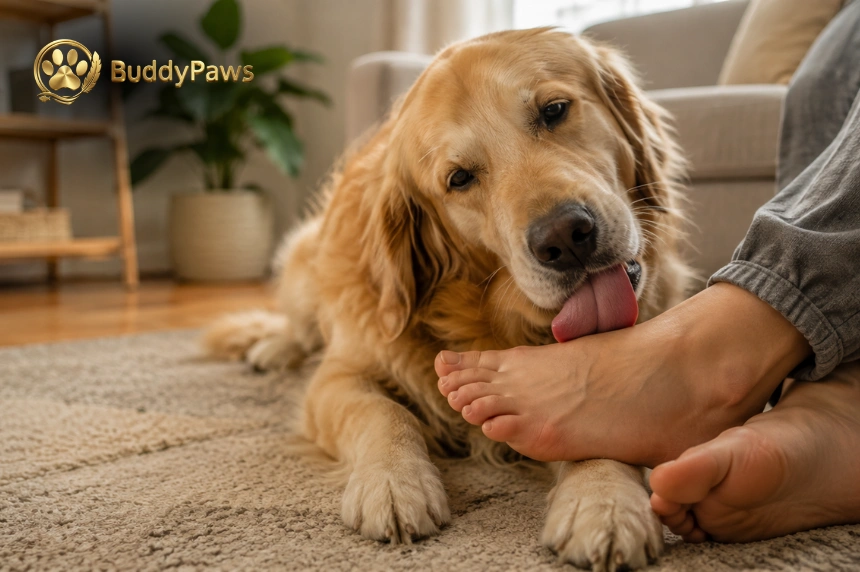
You sit down after a long day, take off your shoes, and within seconds your dog is licking your feet.
For some pet parents, this happens once in a while. For others, it is almost a daily ritual.
So, why does my dog lick my feet?
In most cases, the behavior is completely normal. Dogs lick for many reasons, including affection, attention, curiosity, taste, scent, and self soothing. Feet can be especially interesting because they carry strong smells and salt from sweat.
Sometimes, however, frequent licking can become excessive or signal stress, boredom, or another issue worth watching.
Here are the most common reasons behind this unusual but very familiar dog behavior.
One of the simplest explanations for dog licking feet is that feet smell interesting.
Dogs rely heavily on scent to understand the world. Your feet carry information about where you have been, what surfaces you walked on, and even your natural body odor.
Sweat can also leave a slightly salty taste on the skin, which some dogs seem to enjoy.
To your dog, your feet are not just feet. They are a source of scent information.
This is similar to other behaviors where dogs use smell to understand people and their surroundings. If you enjoy learning about everyday canine habits, read our guide on why dogs sniff everything on walks.
Dogs often use licking as a social behavior.
A dog may lick your hands, face, legs, or feet simply because they feel comfortable around you and enjoy interacting with you.
This does not mean every lick is a direct expression of love, but licking can definitely be part of bonding behavior.
If your dog also:
then foot licking may simply be another way they interact with someone they trust.
You can explore this bond further in 8 signs your pet thinks you are part of their pack.
Dogs quickly learn which behaviors make humans react.
If your dog licks your feet and you immediately:
your dog may learn that licking your feet gets attention.
Even negative attention can sometimes reinforce a behavior.
From your dog's perspective, a reaction is still interaction.
If the behavior has become frequent, pay attention to what happens immediately afterward. You may accidentally be rewarding it without realizing it.
Your dog knows your smell incredibly well.
Clothing, bedding, shoes, and skin all carry familiar scent cues.
Feet may be particularly interesting because they contain many sweat glands and often have a stronger smell than other parts of the body.
Dogs can use familiar scent as a source of information and comfort.
This may be one reason some dogs are especially interested in licking their owner's feet after they return home.
If your dog becomes particularly attached to your scent when you leave, you may also enjoy Do Dogs Miss Their Owners When They Are Away?.
Some dogs lick as a way to calm themselves.
Repetitive licking can help dogs settle during moments of excitement, uncertainty, or mild stress.
If your dog tends to lick your feet while relaxing beside you, the behavior may be comforting.
However, excessive licking can occasionally be associated with anxiety.
Watch for other signs such as:
If several of these behaviors occur together, stress may be playing a role.
Boredom can create all kinds of repetitive behaviors.
A dog with limited stimulation may lick people, furniture, floors, or themselves simply because there is nothing more interesting to do.
Ask yourself whether your dog is getting enough:
If your dog seems restless or constantly looks for attention, more enrichment may help.
You can also read 7 clear signs your pet wants to socialize more for more clues that your pet may need additional interaction.
Sometimes a behavior begins for one reason and continues simply because it becomes routine.
Maybe your dog first licked your feet because they smelled salty.
You laughed.
Then they did it again.
Weeks later, it became something they automatically do whenever you sit down.
Dogs are very good at learning routines.
If the behavior is harmless and does not bother you, you may not need to change it.
If you want it to stop, consistency matters.
Not every dog behavior has a deep explanation.
Some dogs just lick more than others.
Personality, breed tendencies, early experiences, and learned behavior can all influence how much a dog uses licking as a form of interaction.
A naturally affectionate dog may lick frequently.
Another dog may barely lick anyone at all.
Both can be completely normal.
Yes, usually.
Occasional foot licking is generally harmless if your dog is otherwise healthy and relaxed.
It becomes more important to pay attention when the licking is:
The pattern matters more than the behavior itself.
That depends on your preference and hygiene.
For most healthy adults, occasional licking of intact skin is unlikely to be a major issue.
However, you should avoid letting your dog lick:
You should also wash your feet after using chemicals, topical treatments, or products that could be harmful to pets.
If you do not like the behavior, it is perfectly fine to discourage it.
If you want your dog to stop, focus on redirection rather than punishment.
Try these steps:
Do not yell or react dramatically.
A big reaction can make the behavior more interesting.
Offer:
When your dog settles without licking, reward calm behavior.
More physical and mental activity can reduce boredom related licking.
A consistent routine also helps. You can explore ideas in our guide to creating a daily routine for a happy dog.
This can happen because your feet smell different after bathing.
Water, soap, lotion, or fresh skin scents can make them more interesting.
However, be careful with skincare products.
Some creams, essential oils, and medications can be unsafe for dogs if ingested.
If you have applied anything to your feet, prevent licking until you know the product is pet safe.
Nighttime licking may become part of your dog's relaxation routine.
If your dog usually lies beside you in the evening, licking may be associated with:
If the behavior is gentle and occasional, it is usually not something to worry about.
Foot licking is usually harmless.
However, talk to your veterinarian or a qualified behavior professional if your dog:
A sudden increase in repetitive behavior is worth investigating.
If you have been asking why does my dog lick my feet, the answer is usually simple.
Your feet smell interesting, taste slightly salty, and belong to one of the most important people in your dog's world.
For many dogs, licking is simply a combination of curiosity, affection, habit, and attention.
As long as the behavior is occasional and your dog is otherwise healthy, there is usually no reason to worry.
What matters is noticing when normal behavior suddenly becomes excessive.
Understanding these small habits can help you learn more about how your dog communicates and what makes them feel comfortable.
At BuddyPaws, we celebrate all the strange, funny, and meaningful behaviors that make every pet unique. Explore more dog behavior and pet care stories, connect with other pet parents, and share the little moments that make life with animals special.
Loading blogs...